
[ad_1]
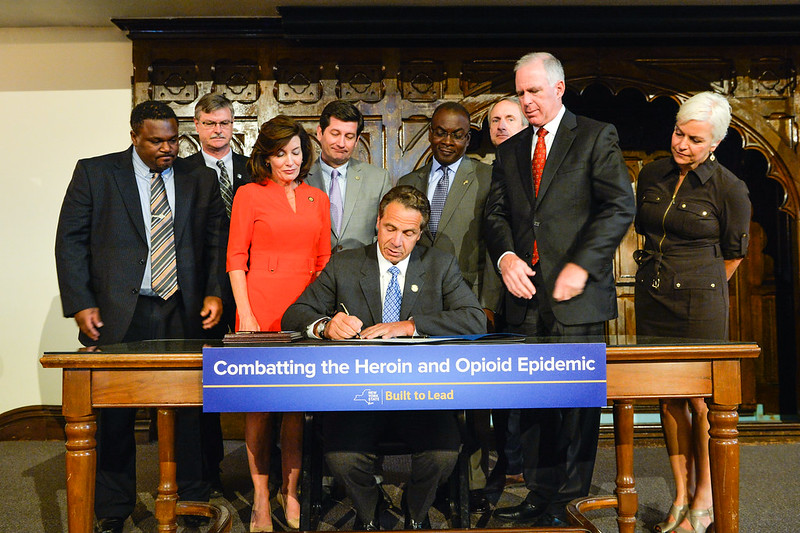
Then, governor. Cuomo signs legislation (photo: Darren McGee / Office of Governor Andrew M. Cuomo)
After the highest number of overdose deaths recorded in New York State in a single year, advocates and substance treatment providers are asking Gov. Kathy Hochul to sign what they call crucial legislation to reverse the trend. . They say without the new governor’s signature, the state’s newly established two-tier substance use treatment system, with more barriers to access for lower-income New Yorkers, will continue and cause more damage.
Drug-assisted treatment (MAT) is a proven tool to help people suffering from substance use disorders. It prevents overdoses, emergency room visits and hospitalizations, and ultimately saves lives. But until recently, New York State required insurers to provide prior authorization to physicians before they could prescribe MAT drugs, such as buprenorphine and methadone, to patients.
In late 2019, then-Governor Andrew Cuomo signed a bill that removed prior authorization for commercial insurers, expanding access to life-saving drugs. But with the same pen, he vetoed another bill that would have removed this regulation for Medicaid, on which the lowest incomes depend, mostly black, Latino, and Asian New Yorkers. The governor’s decisions effectively created two separate systems, removing barriers for commercially insured patients, keeping them in place for Medicaid enrollees.
This Friday, October 1, the state health department is also set to establish a new state form for MAT drugs, taking a unique approach to a much more complicated issue.
“When it comes to anything in healthcare, a one-size-fits-all fit doesn’t fit all patients and your healthcare provider should have the right to decide which treatment works best for you,” said Sen. Pete Harckham, who sponsored both bills to remove prior authorization.
Following Cuomo’s veto, the state legislature passed the Medicaid-related bill this year with overwhelming bipartisan support, as part of an overdose prevention package. Lawmakers, advocates and treatment providers are optimistic, as they urge Governor Hochul to sign the bill that Cuomo vetoed earlier.
Cuomo’s reason for vetoing the bill was that it would increase state spending on Medicaid. But, as advocates point out, this argument was flawed and ignores the cost of human lives to prevent access to MAT drugs. A 2019 RTI International report for the Legal Action Center, a group of nonprofit legal and advisory services, found that removing a prior authorization would save nearly 600 lives each year in New York, would mean a cost savings for to Medicaid of about $ 52 million annually and would reduce hospitalized hospital admissions and emergency room visits by 42%.
Dr. Justine Waldman, CEO of REACH Medical, an Ithaca-based harm reduction provider, said patients with drug-assisted treatment would benefit from a variety of drugs instead of a single drug that can be allow according to the new state policy. “Given that it’s a drug that keeps people alive, we really need to have that flexibility to find the drug that works for them,” he said.
Any additional administrative hurdles can reduce participation in treatment programs, Waldman said, and without first reducing opioid use, the state cannot eliminate it. “If you do it all based on the elimination of use completely, you will not treat a disease process, but you will treat a kind of moral process,” he said.
The need for greater action against the overdose crisis has also never been more urgent. In 2020, overdose deaths increased nationally by about 30%, to more than 93,000. In New York, the Cuomo administration reduced funding for syringe exchange programs, forcing many providers to lay off staff and reduce services, further aggravating the crisis and causing increases in overdoses and outbreaks of STDs. , according to experts. According to the latest CDC data, New York reported 5,129 overdose deaths between February 2020 and February 2021, 34.3% more than the 3,817 overdose deaths in the same period from 2019 to 2020.
“New York State should do everything possible to make sure we’re changing the current,” said Jasmine Budnella, drug policy coordinator for VOCAL-NY, an advocacy and services group.
“We have a time in New York to chart a whole new path and there has never been a better time to have true statewide leadership to sink into interventions and solutions,” he added.
Budnella is among advocates who spent months negotiating with the Cuomo administration to allow greater access to MAT drugs, especially for those taking Medicaid. But even though the administration agreed to enforce these demands through a policy, the new drug formulary does not achieve the goal. Instead of making sure that all MAT medications would be “preferred” and therefore do not require any prior authorization, several medications continue to require it and have dosage limits.
“[W]If you had, there was an indication that the Cuomo administration wasn’t too concerned about creating this two-tier system and specifically about not expanding access for the Medicaid population, which are obviously low-income color communities. ” said Christine Khaikin, a lawyer at the legal action center.
Hochul, a Democrat with just over a month in office as governor, has expressed interest in tackling the crisis of substance use and overdose more fully. In her first public speech as governor, she spoke about her own personal experience as she had lost her nephew to a fentanyl overdose in 2017 and said the issue would be the top priority.
“Too many of our families have had to deal with this spectrum of dealing with someone and have sometimes lost someone they were deeply concerned about because of addiction,” he said on Aug. 26 when he announced Senator Brian Benjamin as Lieutenant Governor. “So for these families, I know the pain that is going on and we will make sure we do everything in our power to stop it,” he added.
“The fight against the opioid epidemic is a top priority for Governor Hochul, as he has been co-chair of the New York Heroin and Opioid Working Group for years,” Governor’s spokeswoman Haley Viccaro said in a statement. reported in Gotham magazine. “She was also personally affected by the crisis and lost a nephew to addiction several years ago. Governor Hochul will continue to fight for protections for New Yorkers fighting substance abuse in collaboration with affected families and groups. The governor is reviewing the legislation and will soon have more to say about it. “
Hochul’s comments have been encouraging for those who have worked on substance use legislation for years. “It’s refreshing to have a governor who understands the pain, grief, and frustration New York State has gone through over the overdose crisis,” Budnella of VOCAL-NY said.
“I think she’s been a lot more willing than her predecessor to take on some of these issues,” said Senator Harckham, a Hudson Valley Democrat who chairs the alcoholism and substance abuse committee and has been shown. open about their own struggles with substance use.
As Harckham noted, the state is also about to have federal aid funds to combat the overdose crisis and is expected to receive up to $ 1.6 billion through lawsuits against manufacturers and distributors. of opioids filed by the Attorney General’s Office Letitia James.
“Therefore, we will have new revenue in state coffers that will be aimed at addressing substance use disorder, and that drug-assisted treatment and equity in drug-assisted treatment should be at the top of the list.” , said Harckham.
For providers, Hochul’s focus is on lives rather than cost. “This is a governor who will really pay attention to health equity and put health equity above its cost, and that makes me very hopeful that this is our governor,” Waldman said.
[ad_2]Source: https://www.gothamgazette.com/state/10797-overdose-deaths-two-tiered-addiction-treatment-new-york [ad_2]
Methadone Clinic In My Area – Methadone Clinic New York City – Methadone Clinics USA


